
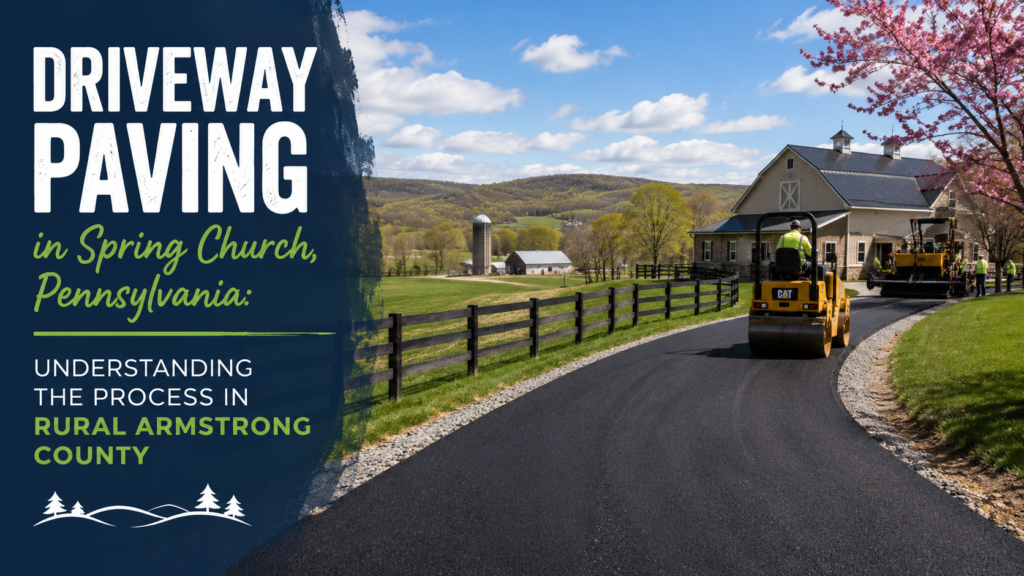
Spring Church, situated along Route 56 in Armstrong County’s Kiskiminetas River valley, is surrounded by the rolling hills and rural landscapes that define Western Pennsylvania’s character. Driveways in this community serve harder working lives than their suburban counterparts rural properties often host heavier vehicles, farm equipment, and delivery trucks that demand robust pavement systems. The terrain is frequently challenging, with grades and drainage considerations that require more planning than flat suburban lots. And the climate cold winters with regular freeze-thaw cycling, wet springs, and warm summers tests every paved surface consistently. Understanding what Driveway Paving Spring Church involves helps property owners make informed decisions about one of their property’s most essential and most used features.
Asphalt Driveway Paving: The Standard in Western Pennsylvania
Asphalt is the dominant driveway paving material throughout Western Pennsylvania, including the Spring Church area. The reasons are practical: asphalt’s flexibility makes it more tolerant of freeze-thaw ground movement than rigid concrete; it can be installed on grades and in terrain configurations that would be challenging for concrete; and when repairs are needed, asphalt patches blend with the original surface more effectively than concrete repairs.
For rural properties in Spring Church where driveways may be longer, steeper, or more heavily loaded than typical residential applications, the quality of the asphalt installation is particularly important. A driveway that must support loaded pickup trucks, tractors, or delivery vehicles needs a heavier base course than one supporting only passenger cars. Getting this specification right from the outset prevents premature failure under loads the pavement was not designed to carry.
Gravel Driveway Surfacing: A Rural Alternative
Many Spring Church properties have gravel driveways rather than paved surfaces, and this is entirely appropriate for many rural applications. Gravel driveways maintained with proper crowning, drainage, and periodic gravel replenishment can serve rural properties effectively at lower initial installation cost. They handle heavy loads, do not crack under freeze-thaw movement, and can be built and maintained with standard grading equipment.
The decision between asphalt paving and gravel surfacing for a Spring Church driveway depends on several factors: the frequency and type of vehicle use, the importance of dust control (gravel drives generate significant dust in dry conditions), the length and grade of the driveway, and the property owner’s preference for appearance and maintenance requirements. Experienced paving contractors in Armstrong County can help property owners think through these factors before committing to a material choice.
Site Assessment Before Driveway Paving
Before any driveway paving project in Spring Church begins, a thorough assessment of the site establishes what preparation is needed. Key assessment elements include:
- Existing surface evaluation: Is there an existing surface that needs to be removed, or is this a new installation on previously unpaved ground? If an existing asphalt driveway is present, what is the condition of the base? Can the existing surface be overlaid, or does the base need replacement?
- Grade and drainage assessment: How does water currently flow across the driveway area? Are there drainage problems ponding areas, erosion points, or drainage toward the structure that need to be corrected in the new design?
- Subgrade evaluation: What is the condition of the soil beneath the proposed pavement? Are there soft spots, organic material, or drainage issues in the subgrade that would compromise a new base installation?
- Load considerations: What vehicles will use this driveway? Heavier vehicles require deeper base courses and heavier asphalt surface courses.
- Grade management: Steep grades require special attention to drainage, surface texture (for traction), and base compaction to prevent differential settlement.
The Driveway Paving Installation Sequence
A properly installed asphalt driveway in Spring Church follows a defined sequence:
- Excavation and sub-grade preparation: Existing material is removed to the required depth, organic material is excavated and replaced with clean compactable fill, and the sub-grade is shaped to the design grade and compacted.
- Aggregate base installation: A layer of crushed limestone or quarry process aggregate typically 4 to 6 inches for residential applications is spread, graded, and compacted. In Armstrong County, where locally quarried limestone is readily available, this is the standard base material.
- Edge preparation: Driveway edges are established to provide lateral support for the asphalt surface and prevent edge raveling.
- Hot mix asphalt installation: Fresh hot mix asphalt is delivered from the plant and spread to the specified thickness. In Spring Church, timing the haul from the asphalt plant to maintain proper material temperature is a practical consideration for contractors.
- Compaction: Steel drum rollers compact the asphalt through multiple passes, achieving the required density and creating the smooth, durable finished surface.
Managing Grades and Drainage on Spring Church Driveways
Rural properties in Spring Church frequently feature more significant grade changes than suburban lots. Driveways that climb or descend hillsides, cross natural drainage channels, or span significant elevation changes from road to house present drainage challenges that must be addressed in the pavement design.
Key drainage management elements for graded driveways include:
- Cross slope: The driveway surface should be sloped transversely from center to edge to shed water off the surface rather than allowing it to concentrate and run along the driveway.
- Culverts: Where natural drainage channels cross under the driveway, culverts must be correctly sized and installed to convey the design storm flow without backing up against the driveway embankment.
- Drainage ditches: Interceptor ditches alongside and above driveways on hillside properties redirect runoff before it can cross the driveway surface and cause erosion.
- End-of-driveway transitions: The connection between the driveway and the public road must be designed to prevent stormwater from the driveway from draining onto the road surface.
Maintaining Paved Driveways in Western Pennsylvania’s Climate
Once a driveway is paved in Spring Church, a maintenance program appropriate to Western Pennsylvania’s climate will maximize its service life. The key maintenance practices are:
- Sealcoating: Applied 6 to 12 months after installation and every 2 to 3 years thereafter, sealcoating protects the asphalt binder from UV oxidation and moisture infiltration.
- Crack filling: Cracks that develop from temperature cycling or minor sub-grade movement should be filled promptly with rubberized asphalt filler before water infiltration and freeze-thaw damage can enlarge them.
- Winter maintenance: Careful snow removal that avoids damage to the asphalt surface, and judicious use of deicing materials (excessive salt application can accelerate asphalt deterioration at the surface level), preserves the pavement through the season.
Conclusion
Driveway paving in Spring Church, Pennsylvania involves the same fundamental principles of sub-grade preparation, base installation, and asphalt placement that govern quality pavement work anywhere, adapted to the specific demands of Armstrong County’s terrain, climate, and the heavier-than-typical vehicle loads common on rural properties. Property owners who understand this process and who work with contractors who bring local knowledge of the area’s soil conditions and terrain invest in driveways that serve their properties reliably through Western Pennsylvania’s seasons.